
News
Client Story: Hal Hays Construction Transforms Tucson
Originally Printed in "On The Job" Magazine 07/2024
Celebrating 33 years of service, Hal Hays Construction, Inc. (HHCI) is a large, family-owned Native American contracting business. It has established itself as an industry leader throughout the Southwest United States and beyond.
Through the years, HHCI has successfully delivered thousands of multi-disciplinary projects. Customers include the U.S. Department of Defense, public utilities, and Fortune 500 companies. HHCI has proven itself handling a wide variety of project sizes ranging from heavy civil and infrastructure, to building construction, and many other project types.
Growing up during the 1990s in Southern California, Kirby Hays remembers not seeing his dad and company founder, Hal for weeks at a time during wildfire season. After working in his family’s Northern California logging business for 21 years, Hal had transitioned to fighting wildfires as logging declined.

In 1991, Hal Hays moved south to Riverside, Calif., where he launched the construction business with a bulldozer, an excavator and a truck. A Native American, Hal specialized in what he knew best—forestry services, wildland firefighting, and ecosystem rehabilitation.
“When the company was founded, I was six years old,” says Kirby. “Accompanying my dad on Saturday morning visits to our Cat® dealer’s parts counter are among my earliest memories. We all lived at my grandma’s home, and my dad handled equipment maintenance on weekends.”
Ten years later, HHCI was accepted into the Small Business Administration 8(a) program, which was created to help firms owned and controlled by socially and economically disadvantaged individuals. Businesses that participate in the program receive training and technical assistance designed to strengthen their ability to compete effectively in the American economy.
HHCI would go on to become the preeminent 8(a) contractor in the Southwestern U.S., expanding into nine states. Service areas encompassed the federal, military, and governmental marketplaces, including heavy and civil construction, commercial and institutional buildings, site preparation and demolition, emergency response, and utility system construction.
By the time HHCI graduated from the 8(a) program in 2011, it had become one of the most successful 8(a) contractors of all time. As a result, the company has received extensive recognition for its many accomplishments.
From humble beginnings, starting with two pieces of heavy equipment, HHCI now owns 290 pieces of equipment. From initially providing service to three customers, today HHCI has more than 100 major customers throughout the Southwest and Midwest. Starting with a small dedicated group of employees, HHCI has grown to 240 loyal team members.
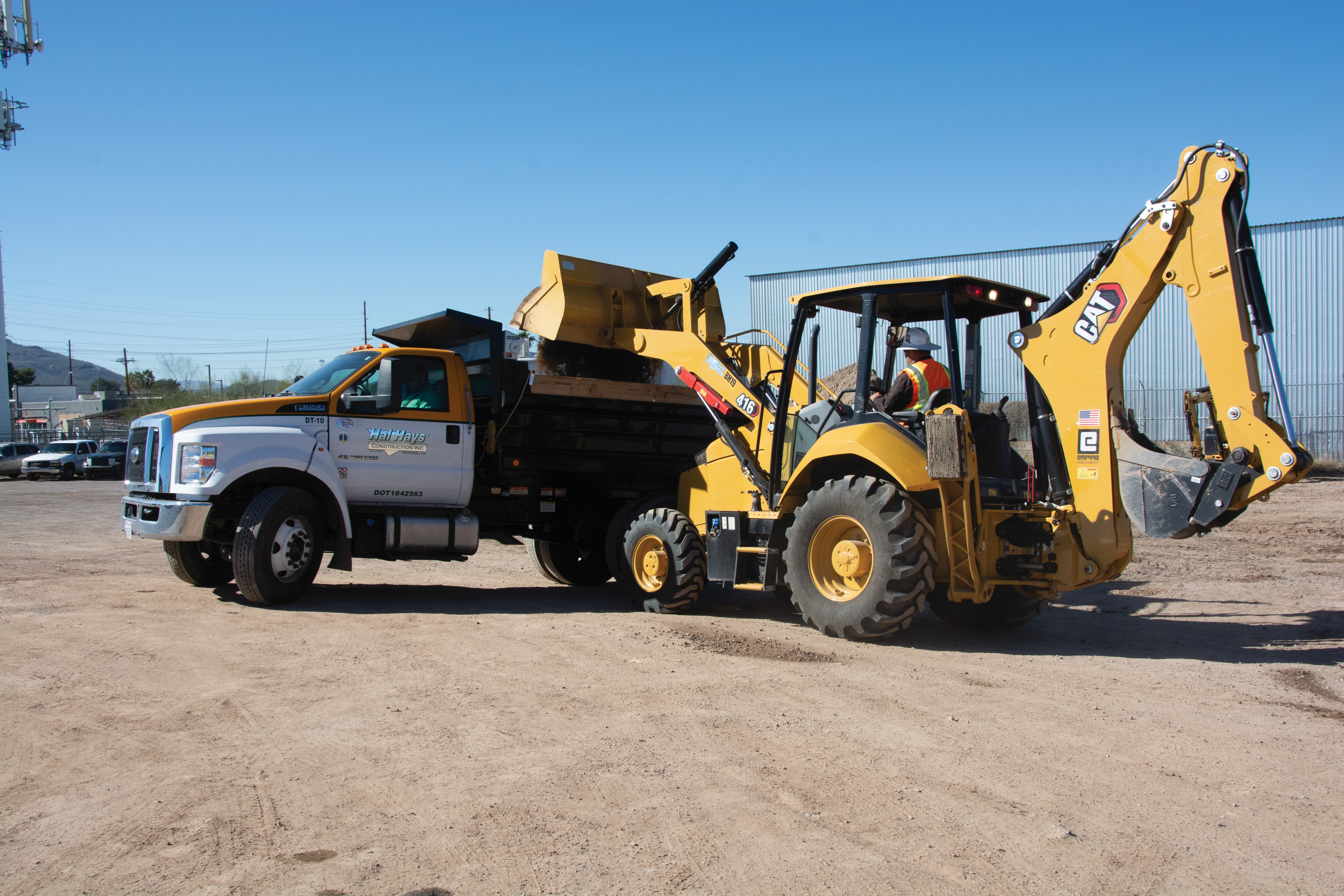
The New Tucson Location
Kirby represents the third generation of Hays entrepreneurship, and carries the same mantra as his father and grandfather: strong work ethic, solid customer partnerships, and delivery of quality work. Kirby delivered HHCI’s first LEED Gold facility and led development within the firm’s transportation market segment. He was named President and CEO in 2013.
HHCI opened a new location in Tucson during April 2023 to install underground utilities for Southwest Gas. The work involves laying gas pipelines in residential areas over a 10-year period.
“We were looking to expand, and the timing just worked out perfectly,” says Hays, who is overseeing the new location.
“There weren’t enough contractors here in Tucson to do the work. We were looking to expand to a new market, and they needed someone like us to come in and help do all of this work.”
Based on the favorable impression that HHCI creates with its crews and trucks in the field, qualified construction workers have left their jobs to come to work for the new contractor in town. By November of last year, HHCI had grown to 80 employees in its new location. The contractor has already outgrown its quarters and is seeking a new location to accommodate the rapidly growing business volume.
“We saw this really as an opportunity of a lifetime,” Hays says. “We knew that there was a huge amount of work here. The gas company told us that HHCI accounted for four times the 2023 work work volume that they had initially planned on us handling.”
In order to do the work for Southwest Gas, HHCI deploys approximately 16 four-man crews. Each crew completes between two to four jobs per week, which equates to installing anywhere from 40 to 55 gas services per week.
“We redid the complete infrastructure for a mobile home park here in town, Hays says. “That was a big one. It was a series of homes where we went from the gas main in the street, and then we were either hand digging, or using a walk-behind trencher to install a line from the main in the street to gas meters adjacent to a home.”
"The 301.7 mini ex has been a godsend for us as far as being able to work in tight spaces, while still having the power to dig through some of the harder surfaces that we encounter.” - Kirby Hays, President and CEO
Cat Machines Do The Work
HHCI installs the gas lines in Tucson with Cat 301.7 Mini Excavators and Backhoe Loaders. Delivering high performance in under two-ton compact size, the small mini excavators are ideal for working in small residential yards. The compact radius design and retractable undercarriage enables operators to access and work in the tightest areas.
“It’s really the tool of choice for what we’re doing here in Tucson,” Hays says. “The 301.7 mini hex has been a godsend for us as far as being able to work in tight spaces, while still having the power to dig through some of the harder surfaces that we encounter.”
Hays and other crew members who came from California were accustomed to working with larger excavators.
“Initially, we thought the 301.7 might be a little undersized,” Hays says. “We kind of felt like we were playing with toys in the beginning. And then to come out to Tucson and do the work with the smaller equipment has really been eye opening. “We like the small mini excavator because it’s a lot more surgical,” he continues. “We’re not moving a lot of earth on these jobs. We’re literally digging an 18-inch deep trench that’s six inches wide.
Our client really emphasizes damage prevention, and the fact that we’ve had so few utility strikes has made us one of the leaders for what we do here. As far as what we do on a daily basis, anytime we’re dealing with homeowners and working in their yards, we emphasize handling the work with the utmost care.”
Before they are cleared to work in the field, HHCI crews receive required training on specific tasks by an in-house safety leader. Crews also hold regular tailgate meetings to review specific jobsite conditions. “If it’s 110 degrees, we’re taking frequent breaks,” Hays says. “Last year in Tucson we worked over 90,000 hours without a single lost-time incident.”
HHCI has plans for further expansion in Tucson by installing gas mains for other utilities.
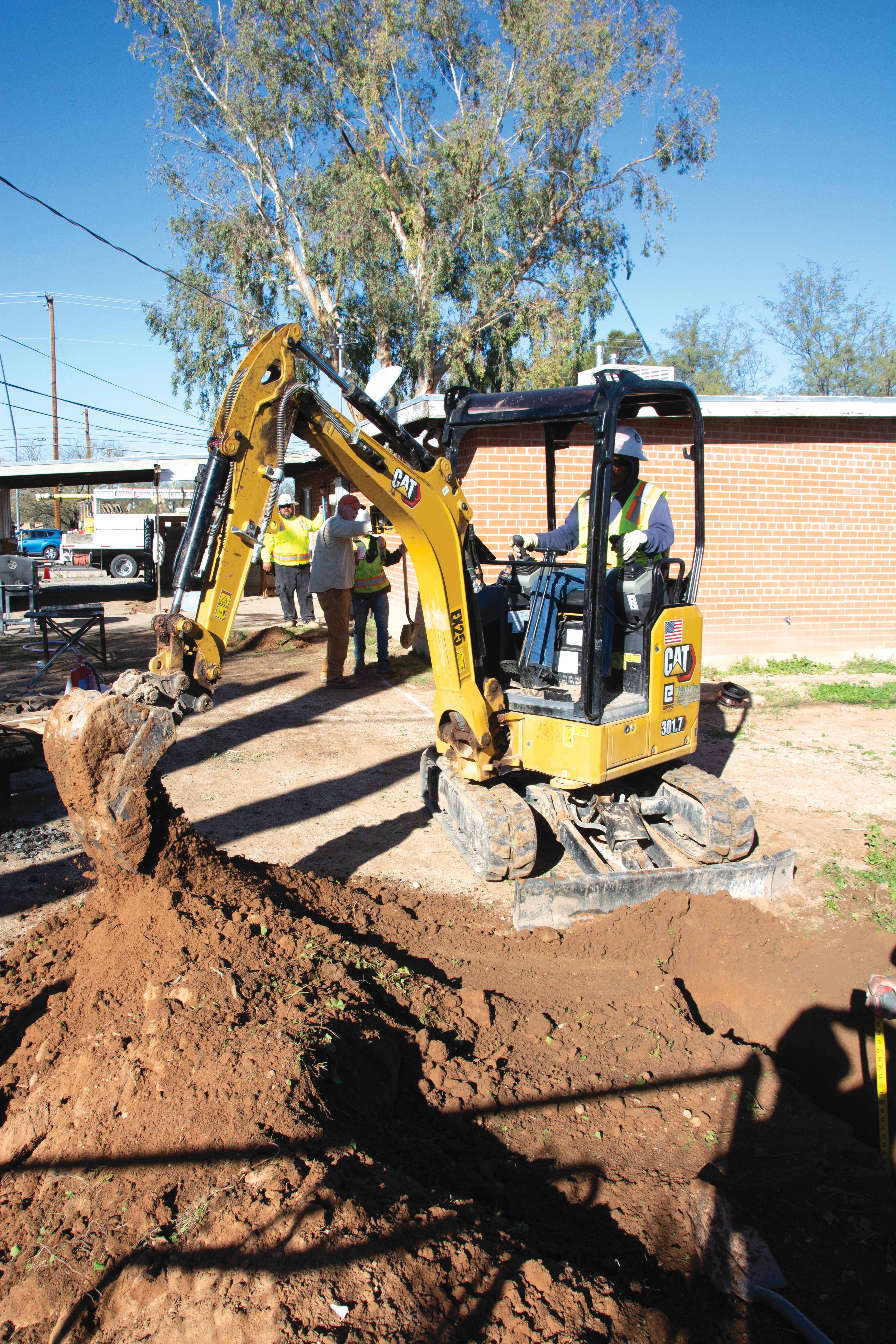
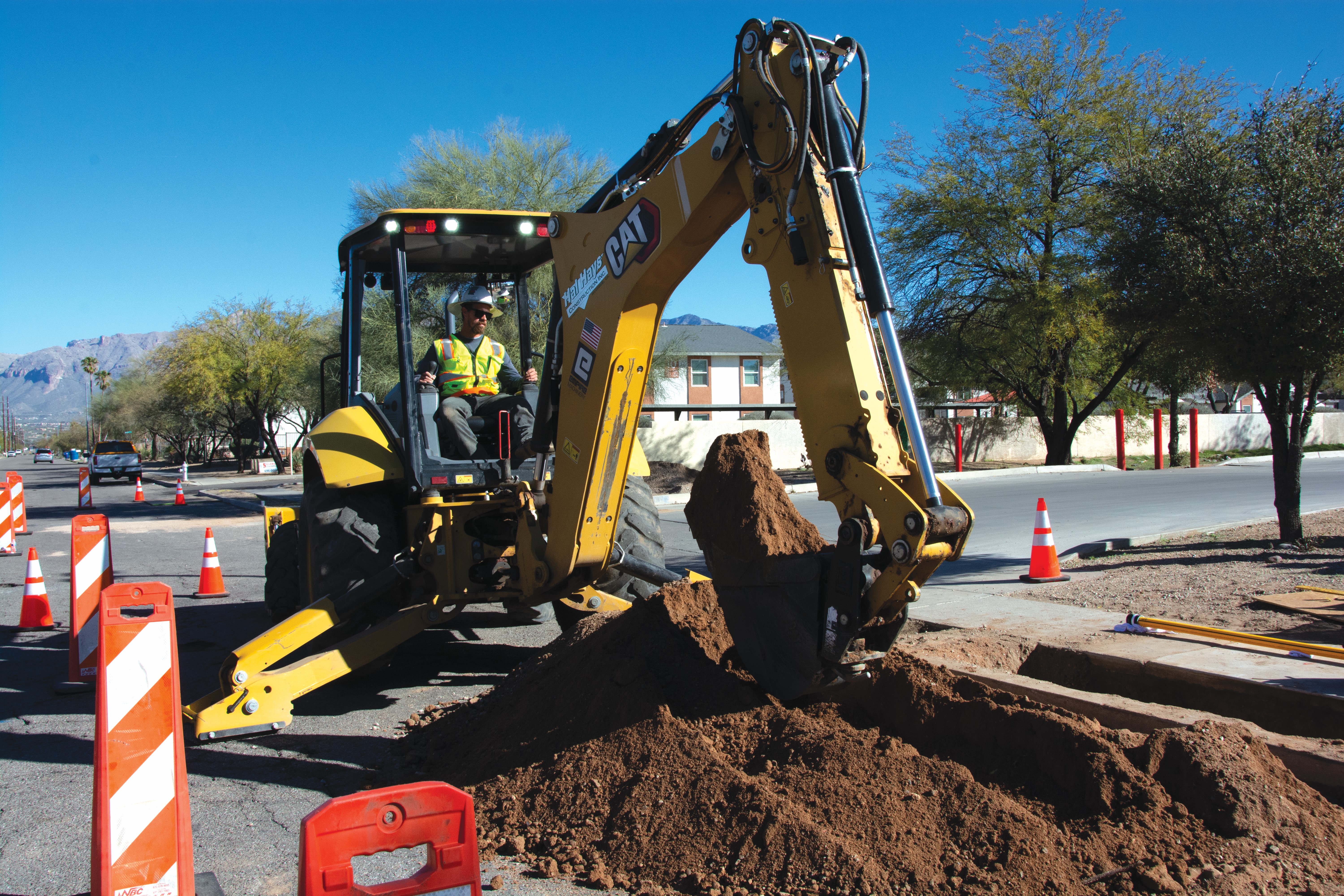
The contractor is well equipped to take on the work, with 26 pieces of Cat equipment and several job-related work tools.
“When we’re working in the street, we like using our Cat 416 and 420 backhoes,” Hays says. “And when we start getting into larger jobs here, we’ll be looking at using Cat 308 Mini Excavators, and also some mid-size wheel loaders.”
Hays appreciates the service he receives from the parts and service professionals at his Cat dealer, Empire Southwest.
“We’ve been treated like not just another contractor,” he says. “Whether it’s obtaining financing from Cat Financial, or receiving notifications from the service department if an issue pops up on one of our machines, we’ve been treated like a partner by Empire. And our sales rep (Matt Steely) does a really good job of taking care of us whenever we need something.”
